Okay, so you recall a few days ago, I wrote that, sadly, we were about to lose our long time feline companion Kallisti. The poor kitty had pneumonia, congestive heart failure, and had suffered a stroke while treating those, had lost the use of most of the left side of her body, and was, on top of all that, not passing feces. We both thought that it was only a matter of time before the cat either passed or before compassion forced us to arrange a coup de grace for her.
But the trouble with that was, we failed to take into account the cat's fierce lineage (including the legendary Mungo Jerry, after which we named our coffee house). Gradually, she got more and more command of her limbs, stubborn beast that she is. The congestion, with the help of meds, cleared from her lungs, her heart rate returned to normal, and today, finally, she began. . . well. . .pooping. I have never been so happy to see a pile of cat droppings.
Kallisti is nearly 18, so we know this is unlikely to be anything like a permanent recovery, but it's pleasing to have our happy and affectionate (and loud) shipmate back prowling the deck, now with a near normal gait.
One tough kitty, and a happy afternoon.
M
Tuesday, March 24, 2015

Friday, March 20, 2015
How to deal with Galley Chores
One of the most frequent questions we get asked here....well, after questions about the composting toilet and ones implying that we're out of our minds for living on a shantyboat...is, oddly, about doing dishes in the galley, so I thought, in the midst of everything else, that I'd take a moment and tell you how we handle that, and successfully.
This is a picture of our galley during installation. Note that the sink is actually an oblong galvanized tub with a drain cut into it. We use a simple pitcher pump to pull water from the river, pump it into the sink, and then drain it into a bladder for disposal on shore.

 We don't just have one tub, we have two identical ones. We use one for wash and one for rinse.
Yes, yes, yes, I know, River Water isn't sterile. We both are food service safety managers and know the risks. So we do what restaurants do that use hand wash. We keep a squeeze bottle of chlorine bleach handy and add it to the rinse water to disinfect the water and the dishes.
 So in practice, once we fill both basins, we add soap and boiling water to the wash basin to raise the temp to around 100F.
So we wash in the warm, soapy water, rinse and disinfect (allowing the dishes to remain in the water for about two minutes) in the second tub, and then air dry.
The system has been surprisingly easy, nobody's gotten sick from it, and it would also work well in any tiny home or cabin. Originally our intention was to nest the two tubs when not in use, but the sink (probably like yours) is too wonderful a catch tub for dirty dishes(one must be careful with this, as it is well known that dirty dishes, left to their own devices, will breed and quickly fill the sink), so we wound up hanging the rinse tub from a hook adjacent to the galley counter.
Today is the first day of spring here, and it is, of course FREAKING SNOWING!!!! I am so tired of this winter. Next week, however, looks quite a bit warmer, and the spring seems to proceed from here. Let's hope.
On the kitty front, much to our surprise, our furry second mate has been steadily improving, gradually getting stronger from her stroke and gaining more and more use of her partially paralyzed limbs. I am glad of this because I had visions of having to rig some kind of Stephen Hawkins motorized cat chair, complete with synthetic speech. Amusing and Terrifying, yes? Anyway, thanks for all your good wishes for Kallisti. We actually do read her your letters.
Okay, its snowing again, and we're bored.
More later. We just put a new recipe and some video over on our small kitchen cooking blog Onboard Cooking, and there are new posts on Morgainne's Artist's site Life, Art, Water. Check em out.
Hey, if you want to know when we post new stuff, hit the subscribe button and we'll make sure you know. If you're of a mind, click on and check out some of our kind advertisers, which is how we're able to afford to do this stuff.
Happy Ostara, Happy Spring, Happy Equinox
M
This is a picture of our galley during installation. Note that the sink is actually an oblong galvanized tub with a drain cut into it. We use a simple pitcher pump to pull water from the river, pump it into the sink, and then drain it into a bladder for disposal on shore.
 |
| Filling the rinse tub. You can see the wash tub, full of dirty dishes, beneath it. |
 | ||
| Warm water not only cleans better, in winter the river water is freakin' COLD! |
The system has been surprisingly easy, nobody's gotten sick from it, and it would also work well in any tiny home or cabin. Originally our intention was to nest the two tubs when not in use, but the sink (probably like yours) is too wonderful a catch tub for dirty dishes(one must be careful with this, as it is well known that dirty dishes, left to their own devices, will breed and quickly fill the sink), so we wound up hanging the rinse tub from a hook adjacent to the galley counter.
Today is the first day of spring here, and it is, of course FREAKING SNOWING!!!! I am so tired of this winter. Next week, however, looks quite a bit warmer, and the spring seems to proceed from here. Let's hope.
On the kitty front, much to our surprise, our furry second mate has been steadily improving, gradually getting stronger from her stroke and gaining more and more use of her partially paralyzed limbs. I am glad of this because I had visions of having to rig some kind of Stephen Hawkins motorized cat chair, complete with synthetic speech. Amusing and Terrifying, yes? Anyway, thanks for all your good wishes for Kallisti. We actually do read her your letters.
Okay, its snowing again, and we're bored.
More later. We just put a new recipe and some video over on our small kitchen cooking blog Onboard Cooking, and there are new posts on Morgainne's Artist's site Life, Art, Water. Check em out.
Hey, if you want to know when we post new stuff, hit the subscribe button and we'll make sure you know. If you're of a mind, click on and check out some of our kind advertisers, which is how we're able to afford to do this stuff.
Happy Ostara, Happy Spring, Happy Equinox
M
Sunday, March 15, 2015
On the Loss of a Beloved Crew Member

Pets aboard ship are always such a joy. Cats in particular seem to adapt beautifully to boating environments, their inherent balance and grace dealing with the motion of the vessel effortlessly, the vessel providing a myriad of close hiding spaces to inhabit, the marine environment full of fascinating sights and smells. Even an elderly kitty like Kallisti, an October kitty who turned 17 aboard ship, seemed to love the boat and it's ways.
We shall miss the Kali-cat, her strong voice, quirky personality, and boundless affection. It is hard, in moments like this, to remember how much our lives have been enriched by our furry and unfortunately short-lived companions. I, for one, shall try very hard to remember.
Sail on, shipmate. Sail on.
 |
| Morgainne and Kallisti |
M
Friday, March 13, 2015
The First Official Signs of Spring:
1) The Ice is Gone
2) Buds on the trees are starting to pop
3) We spotted the first (massive) Osprey a month before they're usually here.
4) The first boat from the Marina was splashed today and
above all
5) WE HEARD THE ICE CREAM TRUCK THIS AFTERNOON.
Mungo and Morgainne do the happy dance.
M
2) Buds on the trees are starting to pop
3) We spotted the first (massive) Osprey a month before they're usually here.
4) The first boat from the Marina was splashed today and
above all
5) WE HEARD THE ICE CREAM TRUCK THIS AFTERNOON.
Mungo and Morgainne do the happy dance.
M
Fascinating Find at the Marina
Our Marina is undergoing a bit of a rebuild, and in the course of that, the attic revealed these:

 These massive gaslights apparently once graced the fact of the old Baltimore City Hall before the great Baltimore Fire.
Anyone having access to old photos from Baltimore from before the fire that might include pictures of the City Hall showing these things actually mounted and in use, drop us a line.
M
Anyone having access to old photos from Baltimore from before the fire that might include pictures of the City Hall showing these things actually mounted and in use, drop us a line.
M
Saturday, March 7, 2015
Preparing for Spring, a Livaboard Checklist
So, on this, what is hopefully the last nasty cold day of winter, I thought I would share with you guys our list for prepping the Floating Empire for Spring.
First Phase (before last frost date)
1) Move to storage our murderously heavy coats, scarves, snow boots, mittens, etc.
2) As the winds will be shifting to the South/Southwest from the North/Northwest (predominantly, of course), reset the south facing stern lines, replacing the chafed ones with new line and shortening the length slightly so a strong south wind at high tide won't bring us into a close encounter of the dock kind.
3) Put away the acrylic thermal blanketing covering the door and windows at night.
4) Use up the stuff in the 'redneck refrigerator',(the cooler on the bow outside) as we won't be able to keep it cold there in a few weeks.
5) Begin shifting over the pantry to things that don't require refrigeration or are less sensitive to heat and humidity.
6) Tidy up the deck on the bow and stern to make room for the stuff that normally lives outside when it isn't freezing outside.
7) Check all the systems that weren't used over winter; running lights, fire extinguishers, life vests, dinghy anchor lines. . . .anything that you might suddenly discover wasn't in working order when you needed it.
After the Last Frost Day:
1) Move to storage our winter duds, heavy blankets, and comforters.
2) Drain and burn out the Kerosene heater.
3) Move the heaters to storage.
4) Shift our fenders into positions more likely to protect us in the new wind directions.
5) Check new line lengths to make sure we don't hit the docks.
6) Remove additional insulation and open all the windows. Do any repairs on screening or glazing, as needed.
7) Clean and inflate our dinghy. Attach outboard mount and electric motor.
8) Bring out of storage the bathing suits, summer clothes, sun hats, sunblock, water socks, and other summertime accouterments.
9) Shift stocking of our breakfront to things for our summer menu.
10) Drag out and clean the grill and do any touch up painting necessary.
11) As soon as weather permits, to exterior paint and touch up on the shanty boat, painting over the spar varnished things that didn't hold up well with a good exterior latex.
12) Finish the sign for 'The Drinking Tree Grove', restock the wine cabinet, buy decent sunglasses, and in general shift into social/party season mode.
13) Assemble and plant our vertical garden on the bow.
14) Enjoy the decent weather.
I have never been so glad to see a Spring arrive.
M
First Phase (before last frost date)
1) Move to storage our murderously heavy coats, scarves, snow boots, mittens, etc.
2) As the winds will be shifting to the South/Southwest from the North/Northwest (predominantly, of course), reset the south facing stern lines, replacing the chafed ones with new line and shortening the length slightly so a strong south wind at high tide won't bring us into a close encounter of the dock kind.
3) Put away the acrylic thermal blanketing covering the door and windows at night.
4) Use up the stuff in the 'redneck refrigerator',(the cooler on the bow outside) as we won't be able to keep it cold there in a few weeks.
5) Begin shifting over the pantry to things that don't require refrigeration or are less sensitive to heat and humidity.
6) Tidy up the deck on the bow and stern to make room for the stuff that normally lives outside when it isn't freezing outside.
7) Check all the systems that weren't used over winter; running lights, fire extinguishers, life vests, dinghy anchor lines. . . .anything that you might suddenly discover wasn't in working order when you needed it.
After the Last Frost Day:
1) Move to storage our winter duds, heavy blankets, and comforters.
2) Drain and burn out the Kerosene heater.
3) Move the heaters to storage.
4) Shift our fenders into positions more likely to protect us in the new wind directions.
5) Check new line lengths to make sure we don't hit the docks.
6) Remove additional insulation and open all the windows. Do any repairs on screening or glazing, as needed.
7) Clean and inflate our dinghy. Attach outboard mount and electric motor.
8) Bring out of storage the bathing suits, summer clothes, sun hats, sunblock, water socks, and other summertime accouterments.
9) Shift stocking of our breakfront to things for our summer menu.
10) Drag out and clean the grill and do any touch up painting necessary.
11) As soon as weather permits, to exterior paint and touch up on the shanty boat, painting over the spar varnished things that didn't hold up well with a good exterior latex.
12) Finish the sign for 'The Drinking Tree Grove', restock the wine cabinet, buy decent sunglasses, and in general shift into social/party season mode.
13) Assemble and plant our vertical garden on the bow.
14) Enjoy the decent weather.
I have never been so glad to see a Spring arrive.
M
 |
| Soon |
Thursday, March 5, 2015
Another Quick Note
There is an interesting posting overviewing Kerosene technology over at the Grindlebone organizations Center for Bypassed Technologies website. Full disclosure, this shantyboat started as a project for the center, but you might find it interesting. go over to Grindlebone and click on the Center for Bypassed Technologies link on the left.
Kero, especially with it snowing again, is my friend.
M
Oh, hey, new recipe over on Onboard Cooking. Key Lime Pie. Check it out!
Kero, especially with it snowing again, is my friend.
M
Oh, hey, new recipe over on Onboard Cooking. Key Lime Pie. Check it out!
Sunday, March 1, 2015
Review: Butterfly Stovetop Oven
We were so happy with our Butterfly Kerosene stove, we thought we'd give their stovetop oven a try. The nice folks at St. Paul Mercantile were happy to ship us one (these are great people with which to deal, btw.), and we thought we'd give you a first look at our first few experiments. Based on some reviews we'd seen, we opted to spend the extra $10 bucks
and let St. Paul Mercantile assemble the thing for us. Looking at the
assembly, that was a good choice. Don't make yourselves crazy, let them
do it. The oven showed up well packed, intact, and solid looking and two days earlier than we'd expected it, a good omen.
Let me say up front that we've already done quiet a bit of baking while on the boat, but almost all of it dutch oven cooking outdoors. With the nasty weather of late winter, we began to wish we had another option to the--admittedly delicious--largely one pot meals that had been our staple through most of the winter. Hence the oven.
The oven is basically a black box, similar in form to the folding "Coleman" camp ovens that you may have seen in the past, but far more stoutly made. The critter does NOT fold, and has an open base and some substantial heat reflectors on the interior. The original edition of the oven does not have heat resistant glass in the front, as some users have commented. The folks at St. Paul Mercantile found an outside source and retrofit all theirs with heat resistant glass.
This thing is really solid, with a centigrade calibrated thermometer mounted in the front of the glass. It became pretty apparent on our first try out that that thermometer was wildly inaccurate, and we easily removed it and substituted a calibrated Fahrenheit scale oven thermometer in its place.
Ovens of this type are essentially inverted reflector ovens. They don't have a lot of insulation, heat up quickly, and cool down just as quickly. For a boat, both of these are a plus.
In our first outing, some commercial biscuits, it became apparent that keeping the temperature even is a bit of a challenge and takes some attention and practice. By the time we tried cooking anything serious, though, we rather had it down.
This is a lovely pork roast with potatoes and a plum sauce, which was our first major meal in the oven. It turned out beautifully, as you can see.
All in all, this is gonna be a GREAT addition to our galley. Ovens like this one come with a few challenges, aside from the maintaining of even temperature. The 10.5 X 12" oven space was a bit of a puzzlement to find bakeware to fit. We were becoming frustrated until we noticed at our local Bed, Bath, and Beyond a section with cookware for toaster ovens, all of which fit perfectly, and were of very high quality. Do yourself a favor and look in the toaster oven section first. Since the unit does not break down, finding a storage space was a bit problematic, but the oven itself can be used for stowage when not in use.
Two thumbs up guys, and the combination with Butterfly's 16 wick kerosene stove makes for a really easy to use, competent galley.
More shortly. So happy to have the new computer up and running.
M
Hey we'll be posting new stuff today and tomorrow to our other blogs at Life, Art Water and Onboard Cooking, so kindly stop by and check em out. Oh, and if you'd give a glance to our kind advertisers that make this site possible, we'd appreciate it.
M
 |
| Butterfly Oven with Butterfly 16 Wick stove as sold by St. Paul Mercantile. |
Let me say up front that we've already done quiet a bit of baking while on the boat, but almost all of it dutch oven cooking outdoors. With the nasty weather of late winter, we began to wish we had another option to the--admittedly delicious--largely one pot meals that had been our staple through most of the winter. Hence the oven.
 |
| Oven in effect with our substitute thermometer |
The oven is basically a black box, similar in form to the folding "Coleman" camp ovens that you may have seen in the past, but far more stoutly made. The critter does NOT fold, and has an open base and some substantial heat reflectors on the interior. The original edition of the oven does not have heat resistant glass in the front, as some users have commented. The folks at St. Paul Mercantile found an outside source and retrofit all theirs with heat resistant glass.
This thing is really solid, with a centigrade calibrated thermometer mounted in the front of the glass. It became pretty apparent on our first try out that that thermometer was wildly inaccurate, and we easily removed it and substituted a calibrated Fahrenheit scale oven thermometer in its place.
 |
| Balancing the temperature takes a bit of practice and attention, but once you get it down, it works well. |
 |
| YAY Baked goods! |
In our first outing, some commercial biscuits, it became apparent that keeping the temperature even is a bit of a challenge and takes some attention and practice. By the time we tried cooking anything serious, though, we rather had it down.
 |
| Roast in the oven. High temps are no challenge at all with this thing. |
This is a lovely pork roast with potatoes and a plum sauce, which was our first major meal in the oven. It turned out beautifully, as you can see.
 |
| Left overs? Are you kidding? We may have eaten the pan as well, we're not sure. |
Two thumbs up guys, and the combination with Butterfly's 16 wick kerosene stove makes for a really easy to use, competent galley.
More shortly. So happy to have the new computer up and running.
M
Hey we'll be posting new stuff today and tomorrow to our other blogs at Life, Art Water and Onboard Cooking, so kindly stop by and check em out. Oh, and if you'd give a glance to our kind advertisers that make this site possible, we'd appreciate it.
M
Friday, February 27, 2015
Some Notes at the End of Winter. . . .
. . . or at least we HOPE we've seen the last of the really cold weather.

I thought, with what appears to be the last of the really cold weather behind us, that I'd do a bit of a recap on our experiences in our first winter on Floating Empire, and what we've learned. I say this knowing that some of you liveaboards out there deal with far colder weather than we experience here on the Chesapeake and would love to hear your experiences as well.
First of all, we were rather fortunate at the beginning of the season. Temperatures and winds were mild, and we had just added a bit of insulation to the boat. We found that running our big Kirkman lanterns was enough to raise the internal temperature 15-20 degrees (Fahrenheit), and that snuggling up top in our comforter was just fine in the nights. But when January hit and the temperatures began to drop, it became apparent that we weren't going to be able to keep the temperature at a comfortable level inside the boat. Outside cold was one thing, but strong north winds stripped heat from the structure at a sometimes alarming rate. Since we had connected to shore power for our refrigeration, we purchased a small electric heater just to take the edge off when we were working, running it a few hours during the day at first, then overnights as the temperatures dropped into the 20s. It became apparent that that wasn't going to be enough, and that the expense of running the heater was taking us in the wrong direction vis a vis being off grid.
One of our slip mates loaned us an antique kerosene heater to try. We had been really pleased with our 16 wick Butterfly kerosene cookstove, so we thought we'd give it a try. The results were pretty impressive. I had very little experience with Kero heat before this and was pleasantly surprised. The heat was clean, low odor, dry, and wonderfully persistent.
Based on that experience, we purchased a Dura Heat DH1051, a Korean made 10,500 btu heater, for a little over a hundred bucks new on them interwebs. We were immediately impressed, and things aboard got immediately more pleasant. In fact, we were occasionally getting the loft area too hot.
So on all but the coldest days, we run the kerosene heater down on the main deck, usually in the kitchen area (we get quite a bit of insolation aft in the studio, and that can keep it pretty warm with no help during the days). In the evenings in all but days in the single digits, we burn a few of the Kirkman lanterns blowdecks to keep the chill at bay, shut off the Kerosene heater, and run the little electric up in the sleeping loft at it's lowest setting. This has kept things really quite comfortable. As we move into spring, I suspect we'll reverse the process by which we got here, gradually paring down our heat sources until it's just a few lanterns.
Here I would be remiss if I didn't mention how valuable having our wonderful friends here at the Marina has been. During the winter we've had temperatures down to -1 Fahrenheit, winds gusting to 50 kts, sheet ice across the Middle River, frozen snow on the docks, frozen pipes in the bathrooms. With every extreme event, we were besieged by calls and texts from our slipmates, wanting to know if we were okay, if we needed a warmer place to stay, if we needed a hot bath, a hot meal, laundry. . . . .We were fine, but those calls and texts do a lot to warm a cold winter.
So here are a few notes of the things we had to deal with, things that worked well, and stuff we felt you might like to know: hopefully you'll find them useful.
Boats, by their nature, have limited insulation and very little thermal mass. They heat up quickly, they lose temperature quickly, and wind has more to do with that than either air temperature or water temperature. We learned to carefully mind the windspeed and direction in planning for things like outings and projecting fuel usage.
We sit low in the water. With the accumulation of snow and ice, you sit lower. We wound up being rather circumspect about clearing snow from the bow, breaking ice off the lines, and doing what we can to remove the ice accumulation from the sides of the boat. Lapping water on our low side rails, with a cold north wind, leaves an accumulation of ice along the sides of the boat. The weight is noticeable. In spring we'll be adding a set of walkways to the sides of Floating Empire which will allow us to more easily deal with things like that.
Floating Empire has no pressurized water system, so freezing really wasn't an issue, though we did manage to get the line plugged with ice on a couple of occasions. We built the boat so that our water lines into the river could be retracted, so on REALLY cold nights, we would retract the line to our pump and drain it which ended any of our ice problems.
Even with the river and the marina around us frozen to a depth of four or five inches, we still never had any ice beneath the boat between our floatation. This meant that river water was always available, which is a serious plus as, in a pinch, we can filter that to potability.
Our lexan windows didn't have enough play in them to account for the extreme contraction caused by the cold, and we got some cracking around the mounting screws. In future, we'll have to allow them to have a bit more play.
Condensation was FAR and AWAY more of a problem than we'd anticipated. As the membrane got cold, interior humidity first condensed and then froze in a sheen along the inside, beneath the ecofoil insulation. When things warmed up, it occasionally rained. . . . .
. . . . over the bed. The first time it happened we were. . .um. . .occupied, so it was all the more startling. The addition of some DampRid containers and our small dehumidifier has really helped, but the problem does persist. We are open to suggestions.
Things on a boat get messy in winter. Wet boots accumulate by the door. Nobody wants to go out in the snow to get the kero, so you wind up with a couple of small containers of it by the door as well. The trash piles up. You have heavy clothes, heaters, boots, all manner of things out and in use and in the way. Things get dirty, particularly the flooring, and things that are easy to clean or deal with in summer suddenly become awkward and cumbersome in winter. It's the same with a house on land, but in a small space on the water, it becomes amplified. I can't just set the trash outside, there's WATER out there. You get the idea.
Extreme low tides, driven by north winds, literally at times extracted ALL the water from under us. I mean that literally. I could open the floor hatches and I was looking at dirt. This made getting off and on the vessel chancy at those times, and rather increased the isolation of the winter.
After a busy summer, full of parties and people and friends and noise, the Winter was a welcome respite. We were often alone in the Marina, the river is beautiful, the wildlife active year round about us, and the quiet was nice. But as the winter progressed, there were increasing numbers of days where just getting OFF the boat was impractical. We contented ourselves by making amazing meals and watching downloaded films, but when our elderly Mac died, I nearly went out of my skull (Morgainne is far more self-sufficient than I). We have weathered the winter just fine, and we finish it healthy and happy, but ready for spring.
I'm not sure the cat noticed at all.
M
Hey with our computer now back online, we'll be adding more things here and to our other blogs Life, Art, Water and Onboard Cooking. Stop by and give them a look in the coming days.
I thought, with what appears to be the last of the really cold weather behind us, that I'd do a bit of a recap on our experiences in our first winter on Floating Empire, and what we've learned. I say this knowing that some of you liveaboards out there deal with far colder weather than we experience here on the Chesapeake and would love to hear your experiences as well.
First of all, we were rather fortunate at the beginning of the season. Temperatures and winds were mild, and we had just added a bit of insulation to the boat. We found that running our big Kirkman lanterns was enough to raise the internal temperature 15-20 degrees (Fahrenheit), and that snuggling up top in our comforter was just fine in the nights. But when January hit and the temperatures began to drop, it became apparent that we weren't going to be able to keep the temperature at a comfortable level inside the boat. Outside cold was one thing, but strong north winds stripped heat from the structure at a sometimes alarming rate. Since we had connected to shore power for our refrigeration, we purchased a small electric heater just to take the edge off when we were working, running it a few hours during the day at first, then overnights as the temperatures dropped into the 20s. It became apparent that that wasn't going to be enough, and that the expense of running the heater was taking us in the wrong direction vis a vis being off grid.
 |
| Well, better than nothing. . . . |
One of our slip mates loaned us an antique kerosene heater to try. We had been really pleased with our 16 wick Butterfly kerosene cookstove, so we thought we'd give it a try. The results were pretty impressive. I had very little experience with Kero heat before this and was pleasantly surprised. The heat was clean, low odor, dry, and wonderfully persistent.
 |
| The loaner that introduced us to Kero heat |
 |
| Duraheat DH 1051 |
Here I would be remiss if I didn't mention how valuable having our wonderful friends here at the Marina has been. During the winter we've had temperatures down to -1 Fahrenheit, winds gusting to 50 kts, sheet ice across the Middle River, frozen snow on the docks, frozen pipes in the bathrooms. With every extreme event, we were besieged by calls and texts from our slipmates, wanting to know if we were okay, if we needed a warmer place to stay, if we needed a hot bath, a hot meal, laundry. . . . .We were fine, but those calls and texts do a lot to warm a cold winter.
So here are a few notes of the things we had to deal with, things that worked well, and stuff we felt you might like to know: hopefully you'll find them useful.
Boats, by their nature, have limited insulation and very little thermal mass. They heat up quickly, they lose temperature quickly, and wind has more to do with that than either air temperature or water temperature. We learned to carefully mind the windspeed and direction in planning for things like outings and projecting fuel usage.
 |
| Submerged Ice Eater, keeping the surface ice under control. |
Floating Empire has no pressurized water system, so freezing really wasn't an issue, though we did manage to get the line plugged with ice on a couple of occasions. We built the boat so that our water lines into the river could be retracted, so on REALLY cold nights, we would retract the line to our pump and drain it which ended any of our ice problems.
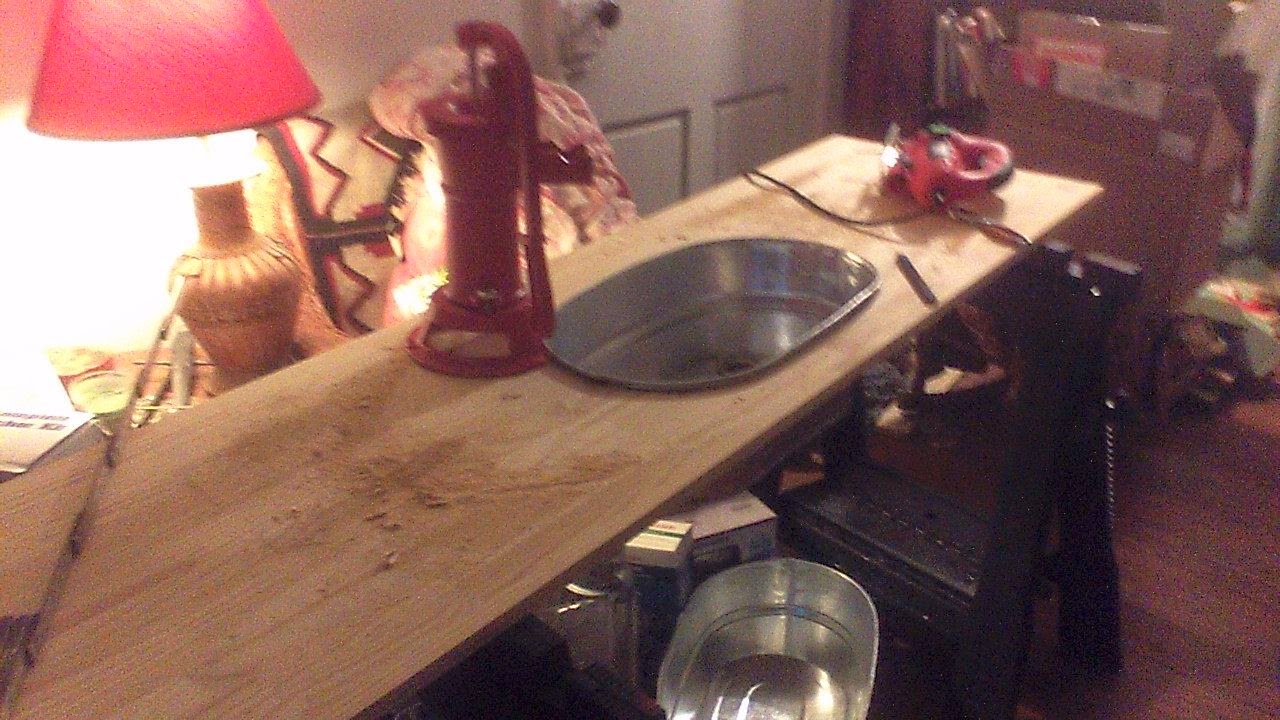 |
| The Galley and Pump assembly under construction. A flexible water line extends through a port beneath the boat, allowing us to retract the water line at will. Graywater goes into a bladder when in port to be dumped ashore. |
Even with the river and the marina around us frozen to a depth of four or five inches, we still never had any ice beneath the boat between our floatation. This meant that river water was always available, which is a serious plus as, in a pinch, we can filter that to potability.
Our lexan windows didn't have enough play in them to account for the extreme contraction caused by the cold, and we got some cracking around the mounting screws. In future, we'll have to allow them to have a bit more play.
Condensation was FAR and AWAY more of a problem than we'd anticipated. As the membrane got cold, interior humidity first condensed and then froze in a sheen along the inside, beneath the ecofoil insulation. When things warmed up, it occasionally rained. . . . .
. . . . over the bed. The first time it happened we were. . .um. . .occupied, so it was all the more startling. The addition of some DampRid containers and our small dehumidifier has really helped, but the problem does persist. We are open to suggestions.
 | ||
| Our amazingly compact little dehumidifier has really helped, but not solved, our condensation problems. |
Things on a boat get messy in winter. Wet boots accumulate by the door. Nobody wants to go out in the snow to get the kero, so you wind up with a couple of small containers of it by the door as well. The trash piles up. You have heavy clothes, heaters, boots, all manner of things out and in use and in the way. Things get dirty, particularly the flooring, and things that are easy to clean or deal with in summer suddenly become awkward and cumbersome in winter. It's the same with a house on land, but in a small space on the water, it becomes amplified. I can't just set the trash outside, there's WATER out there. You get the idea.
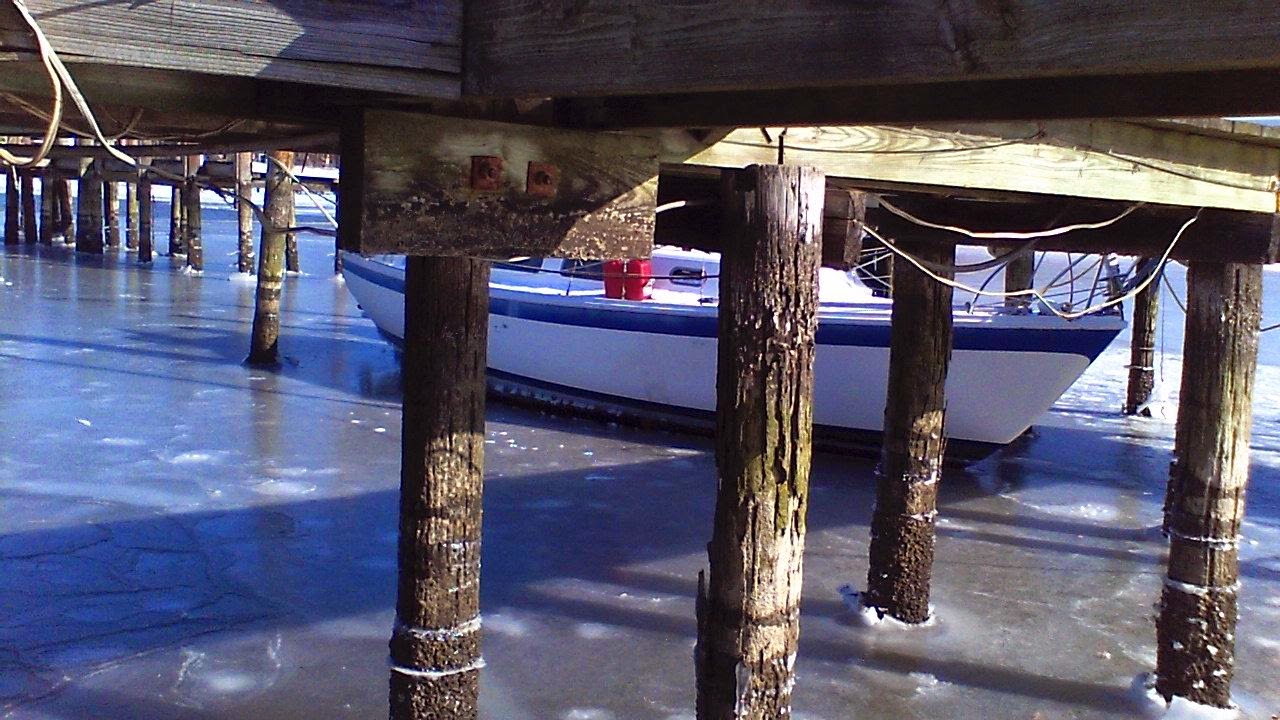 |
| Low tide and strong North winds left a lot of the boats sitting on frozen mud |
Extreme low tides, driven by north winds, literally at times extracted ALL the water from under us. I mean that literally. I could open the floor hatches and I was looking at dirt. This made getting off and on the vessel chancy at those times, and rather increased the isolation of the winter.
After a busy summer, full of parties and people and friends and noise, the Winter was a welcome respite. We were often alone in the Marina, the river is beautiful, the wildlife active year round about us, and the quiet was nice. But as the winter progressed, there were increasing numbers of days where just getting OFF the boat was impractical. We contented ourselves by making amazing meals and watching downloaded films, but when our elderly Mac died, I nearly went out of my skull (Morgainne is far more self-sufficient than I). We have weathered the winter just fine, and we finish it healthy and happy, but ready for spring.
I'm not sure the cat noticed at all.
M
Hey with our computer now back online, we'll be adding more things here and to our other blogs Life, Art, Water and Onboard Cooking. Stop by and give them a look in the coming days.
Wednesday, February 25, 2015
Now is the winter of our electronic discontent
Well, apologies again for our nearly two week absence from the bogs, but our redoubtable, 7 year old MacBook abruptly entered premature senility and died, leaving us with only an archaic android phone with which to deal with them inter tubes. Thanks to the kind folks at Pacific Macs, we are now up and running again and will be catching up with out posts shortly. Thanks for your patience.
There'll be lots of things coming, including a review of our new Butterfly kerosene Oven for the galley, winter road trips around the Middle river, and other stuff, so please keep touch.
Mungo and Morgainne
PS we'll also be adding--finally--to our other blogs Life, Art, Water and Onboard Cooking so stop by and have a look as soon as we can get the new stuff up and running.
There'll be lots of things coming, including a review of our new Butterfly kerosene Oven for the galley, winter road trips around the Middle river, and other stuff, so please keep touch.
Mungo and Morgainne
 |
| Wheeeeeeeee! |
Subscribe to:
Posts (Atom)