Okay, we're having bandwidth problems again. Hope to have these solved shortly, but as soon as they are, we'll be publishing the plans set as a .pdf file. Please keep tuned.
Beautiful and kind of stunningly warm day today on the Chesapeake. Spent part of the day putting wood treatment on the sides of the houseboat, the spar varnish not having worked as well as we'd hoped.
But wow has it been pretty.
more shortly.
Sorry for the interruption.
M
Tuesday, October 28, 2014

Sunday, October 19, 2014
Insulation
So much of this vessel has been playing catch-up with our somewhat premature launch. Through the summer, the highly reflective skin of our membrane kept us cool and sheltered. Now with winter coming on, though, we can see that condensation may start being a problem, not to mention the desire not to find myself a Mungosickle by morning.
So today we began installing a foil backed glorified bubble wrap under the membrane. The one we wound up using was Ecofoil, though there are a number of similar products on the market, including Reflectix and a few others. This is basically two layers of small bubbles clad both sides in aluminized mylar reflective material. The resultant fabric is VERY tough, and with an air gap, you can get about R 7 out of the installation.
 I of course recommend doing this BEFORE you put on the freaking membrane during the original build, but time and money conspired. The Ecofoil is fairly flexible, and VERY resistant to tearing, fortunately. Almost immediately, you can feel your own body heat being reflected back at you.
 But as you can see by the look on Morgainne's face, doing this over your head is hot work, and fatiguing.
 The result, though, is going to be a much more comfortable winter space.


We're lining the interior between the rafters with a selection of cool old tablecloths we've been collecting over the years, which will not only give us something to look at and make the bedroom look a bit less like the interior of a beer can, it will give us another 3" or so of air gap as insulation.

It's time. The trees are turning in a rather spectacular show of color along the river, and tonight will dip into the 30's for the first time this fall.
 All in easy view of our now cozier home.
M
Hey, check out our other Blogs:
Life, Art, Water
Onboard Cooking
Mungo's Forge
Gail Elwell's New Works
So today we began installing a foil backed glorified bubble wrap under the membrane. The one we wound up using was Ecofoil, though there are a number of similar products on the market, including Reflectix and a few others. This is basically two layers of small bubbles clad both sides in aluminized mylar reflective material. The resultant fabric is VERY tough, and with an air gap, you can get about R 7 out of the installation.
We're lining the interior between the rafters with a selection of cool old tablecloths we've been collecting over the years, which will not only give us something to look at and make the bedroom look a bit less like the interior of a beer can, it will give us another 3" or so of air gap as insulation.
It's time. The trees are turning in a rather spectacular show of color along the river, and tonight will dip into the 30's for the first time this fall.
M
Hey, check out our other Blogs:
Life, Art, Water
Onboard Cooking
Mungo's Forge
Gail Elwell's New Works
Tuesday, October 14, 2014
Shantyboat Q and A, Part Deux
Shantyboat Q and A part Deux: Followups
Here’s a few additional questions that came in after our last Q and A. We thought they might be of interest.
Q: How do you deal with the stairs and ladders and such? I would fall.
A: You get used to them, like you get used to the steps and thresholds in your house. In building the boat, we did quite a bit of up and down and up and down stairs. Now that we live here, we don’t even think about it.
Q: I’ve heard some Marinas don’t like liveaboards.
A: Some do, some don’t. The utterly unadvertised truth is: most marinas like at least one or two sets of livaboards. They act as additional eyes and ears for the Marina. In our case, we’ve informed the marina of malfunctioning lights (that they might never have seen), the presence of strangers, Uber high tides in the middle of the night that might have soaked the docking and dock wiring. . .we’ve bailed out boats after heavy rains, alerted fellow slip holders to problems with their fenders and dock lines, and in general made ourselves useful.
It is true, some livaboards have gained a rep for slovenliness and loud partying. We aren’t those kind of folks, and we made that clear to the Marina.
It is also true that some Marinas have a stick up their proverbial butts and are looking only for slip holders that fit their “image.” One of our neighbors here was hung up on by a Marina because their beautiful, classic Ketch wasn’t “new” enough. Others refuse to have any wooden or non-manufactured vessels. The basic rule is: If they don’t want you, why would you want THEM?
Q: Is the boat hard to keep clean?
A: ANYTHING with an elderly, curmudgeonly cat is hard to keep clean. The boat part is actually pretty easy :)
Q: What was the hardest part of the build?
A: For us, it was getting the boat enclosed and our self-imposed time limits. Until the vessel was roofed over and the windows sealed, we were at the mercy of the weather, and it really put us back. Since we had our move already set up, the delay meant that we worked ourselves half to death the last month and put to the waters with what was essentially an unfinished vessel.
Q: Knowing what you know now, what would you have done differently?
A: There are some design changes we’d have made, which I’ve cited in earlier entries. Three things, however, complicated our build from day 1, and those we would have changed. First, we were outdoors, without even a rain or sunshade, and that left us at the mercy of the weather until halfway through the build. Second, we built on really uneven ground, which made keeping things square an issue. As a result, NOTHING on this boat is really square or in line. Third, and we didn’t realize what a factor this would be, we built far from the water and did inadequate research about moving and launching the vessel. It would have saved us money in the long run to rent space in a boatyard for the build, even if it meant a commute to the construction site.
Q: Does the boat rock a lot?
A: No. The boat, like most pontoon boats, is really pretty stable in relatively calm water. They rock far less than traditional hulls. Unless some idiot in a powerboat goes by too fast and throws a wake, we’re only vaguely aware of being on the water at all. Wind can move us around pretty good in the slip during storms, and there is a bit of movement when we hit the end of our dock lines and they stop the boat from drifting. When I replace them, I’m putting in elastic snubbers that will slow the boat slowly when it drifts rather that stopping it somewhat abruptly when the line gets tight.
Q: Would you do it again?
A: In a freaking heartbeat.
Friday, October 10, 2014
On Release of the Plans, recycling furniture, and arts and crafts afloat
We've been slogging away on the plans for you guys, and should get them ready for release before the end of October, '14. {update, it's now going to be more like the first of the year. On consultation, we've made some real improvements to the construction plans. We think you'll be pleased.} The plans will be in a single .pdf file, complete with line drawings and applicable photos from the original construction, and will hopefully enable you folks to build your own barrel shanty avoiding the mistakes we made in ours (along with some of the expense, bleeding, cursing, and general angst). Now I just have to figure out how to get the plans to whoever wants them.
In answer to a frequent question: No, we aren't charging for the plans, they'll be free to download, but we will solicit donations from ya if ya got it.
A decade or so ago I built a set of shelves for my study, and they've followed me through successive moves. Unfortunately, a 6' X 4' bookcase was NOT gonna fit here on the empire. So I knocked them down and transformed them into shelving sets for one of the kingpost sets here aboard.
 Here's the first side going in, anchored to the roof rafters and a kickboard.
 We made space to accommodate a tea chest we had in storage at the bottom, so it becomes pull out storage and seating.

 We also used a cover board at the top to turn our little Ikea snake lights into indirect lighting when we want it.
All in all a rather nice project.
The Marina asked us to do signs for the bathrooms to replace the industrial stick ons they were using. We did a faux distressing on some planking and got fanciful.
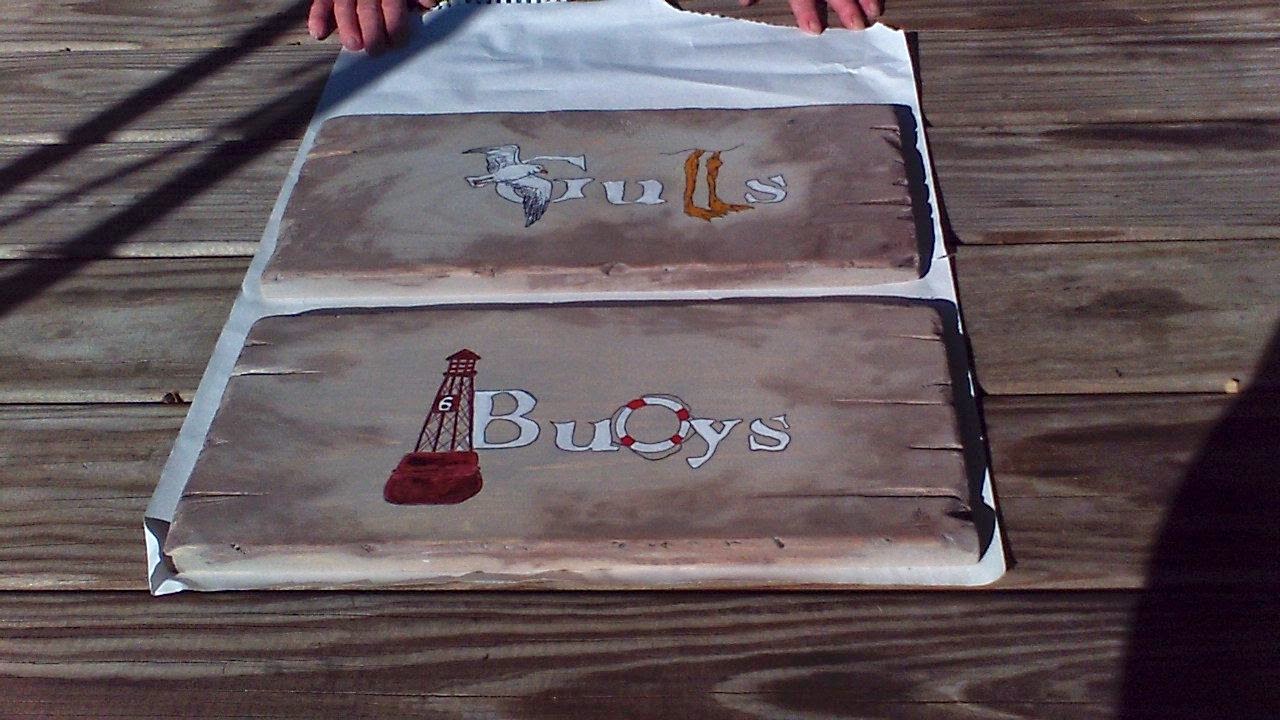 Turned out pretty well, no?
We even had time to go gathering some black walnuts. More on this on our cooking blog, Onboard Cooking soon.

 More shortly. So How do we get you guys the .pdf files? Please leave us suggestions in the comments.
M
Hey, check out our other blogs:
Life, Art, Water
Onboard Cooking
Mungos Forge
In answer to a frequent question: No, we aren't charging for the plans, they'll be free to download, but we will solicit donations from ya if ya got it.
A decade or so ago I built a set of shelves for my study, and they've followed me through successive moves. Unfortunately, a 6' X 4' bookcase was NOT gonna fit here on the empire. So I knocked them down and transformed them into shelving sets for one of the kingpost sets here aboard.
All in all a rather nice project.
The Marina asked us to do signs for the bathrooms to replace the industrial stick ons they were using. We did a faux distressing on some planking and got fanciful.
We even had time to go gathering some black walnuts. More on this on our cooking blog, Onboard Cooking soon.
M
Hey, check out our other blogs:
Life, Art, Water
Onboard Cooking
Mungos Forge
Friday, October 3, 2014
Changes to the Plans
As we gear up to publish construction plans for you good people, I thought I'd take a moment and tell you where the published plans are going to differ from the Floating Empire as we actually built her.
Overhang:
In the original conception of the vessel, there was to be at least a 1' overhang of the roofline all round. This was dropped during construction as it saved time and materials. The overhang, however, would have saved us a lot of the grief we've had trying to get the windows properly sealed, etc. etc. So in your new version of the plans, the overhang is back and better than ever.

Narrower hull:
In consideration of Morgainne's studio space, we opted for a wider hull, which made it impossible for us to easily use standard 8' plywood and dimensional lumber. The result was that we spent a LOT more time and money to wind up with what amounted to about an additional 14" of space. The release plans will make as much use of standard lumber lengths as is possible.

Variable Length:
Since not everyone needs an art studio aboard, we'll be releasing plans for a shorter, easily expandable vessel, ranging from 20'-30'
 Additional Floatation:
While we're floating, and upright even, we've felt since launch that the floatation we used put too much weight on each cell. The new version will have three rows of floats, not two. This minor increase in expense means you will have much greater flexibility in internal layout and fewer worries about weight and loading.
 We'll also be doing improvements and simplifications of things that are working really well on the boat, along with lists of potential sources for inexpensive materials.
So how about it? What else would you like to see included? Cooking recipes? Pet doors? Giant Squid repellent? Please let us know in the comments below.
M
and check out:
Life, Art, Water
Onboard Cooking
our other waterbourn, gonzo, maddening, artful, and slightly odd blogs of life on the water.
Overhang:
In the original conception of the vessel, there was to be at least a 1' overhang of the roofline all round. This was dropped during construction as it saved time and materials. The overhang, however, would have saved us a lot of the grief we've had trying to get the windows properly sealed, etc. etc. So in your new version of the plans, the overhang is back and better than ever.
Narrower hull:
In consideration of Morgainne's studio space, we opted for a wider hull, which made it impossible for us to easily use standard 8' plywood and dimensional lumber. The result was that we spent a LOT more time and money to wind up with what amounted to about an additional 14" of space. The release plans will make as much use of standard lumber lengths as is possible.
Variable Length:
Since not everyone needs an art studio aboard, we'll be releasing plans for a shorter, easily expandable vessel, ranging from 20'-30'
While we're floating, and upright even, we've felt since launch that the floatation we used put too much weight on each cell. The new version will have three rows of floats, not two. This minor increase in expense means you will have much greater flexibility in internal layout and fewer worries about weight and loading.
So how about it? What else would you like to see included? Cooking recipes? Pet doors? Giant Squid repellent? Please let us know in the comments below.
M
and check out:
Life, Art, Water
Onboard Cooking
our other waterbourn, gonzo, maddening, artful, and slightly odd blogs of life on the water.
Sunday, September 28, 2014
The Last Days of Summer
So crossing the vernal equinox into fall, we went into a bit of a flurry of activity, getting some stuff ready for winter and getting the boat all squared away. We paid a visit to our storage and managed to get Morgainne's drafting table out and installed aft.
 It took her all of about six seconds to start using the work space.
 We also completed the rewiring. It is perhaps typical with these things that we managed to wire outlets to everywhere we WEREN'T going to wind up using them. I've added another outlet to the loft for reading lamps and another to the dining area for charging the computer at the dining table, etc.
 So, among other things, now our media loft now has...um...media, set for movie nights on cold winter evenings.
 It, of course, wasn't all work. We went out on this beautiful day to Hart-Miller island with friends.
 we even conned Jamie into scrubbing the bottom of the hull.
 Even Hailey, the adorable bulldog, got on her vest and went for a swim. I think the dog is part duck.
 I swear I think you could use this dog's tongue for a mizzen.
 In the evening, we helped take the Ketch Storyteller to another marine lift to have her hull cleaned and painted.
 The sunsets this time of year are spectacular.
 Enjoy the fall, guys.
 More later,
M
hey, check out our other blogs:
Onboard Cooking
Life, Art, Water
Mungos Forge
M
hey, check out our other blogs:
Onboard Cooking
Life, Art, Water
Mungos Forge
Sunday, September 21, 2014
Lighting
I would have said "Illumination" but I was afraid you'd think I was getting esoteric on you. Actually I do that stuff in another Blog
Light is, weirdly, always an issue on a boat. It's odd since they tend to be such compact spaces, but often windows are weirdly placed and power can be an issue. A 100 watt bulb will easily light up a cabin, but it will also heat it like an ezbake oven and exhaust even the most robust batteries quickly.
Going into Floating Empire, we relied largely on magnetic, LED battery lights. This was a really good idea for spot illumination. Any metal surface could be an anchor for the lights, and the simple addition of a bit of metal stripping or even a fender washer can create an attachment point.
 These little utility lights can stick anywhere, last a long time, and can be easily snapped off as a flashlight when needed.
 We use these little Sylvania touch sensitive led battery lights places like the head for general illumination.
 They're bright and you only have to touch them to turn them off and on, making them easy to find in the dark.
We also put up a few strategic hooks for operating either LED battery lights. . .
 Or our lovely Kirkman oil lanterns, which can also be used as a heat source. . .
 But though these provided point illumination and navigational light, we found that they just didn't create enough interior light for doing work, making dinner, etc etc. Once we got our electrical outgo stabilized, we realized we had plenty of battery and solar power for lighting.
 We acquired some of these LED gooseneck lamps (3W) from IKEA. Two of them supply all the light we need for the kitchen and dining room, and the ability to retarget them where needed makes them convenient for a lot of uses.

 We're using the LED goosenecks to gradually replace the 15W CFL's that we were using as reading lights, etc. Even using them all evening, we still haven't touched our batteries significantly. It's great when you make your own power :). With four of the LED goosenecks working we draw a massive 12 Watts of energy.
More Later
M
Light is, weirdly, always an issue on a boat. It's odd since they tend to be such compact spaces, but often windows are weirdly placed and power can be an issue. A 100 watt bulb will easily light up a cabin, but it will also heat it like an ezbake oven and exhaust even the most robust batteries quickly.
Going into Floating Empire, we relied largely on magnetic, LED battery lights. This was a really good idea for spot illumination. Any metal surface could be an anchor for the lights, and the simple addition of a bit of metal stripping or even a fender washer can create an attachment point.
We also put up a few strategic hooks for operating either LED battery lights. . .
More Later
M
Monday, September 15, 2014
A Shantyboat Q and A
As a preparatory to publishing our first set of plans so you guys can build your own version of Floating Empire, we thought we’d do a Q and A of some of the questions we’ve been asked about building and living on our Shanty.

Q: Why did you do this?
A: There are a number of answers for this one: First, as an experiment. In a world of crashing economies, a growing gap between rich and poor, the destruction of pensions and the safety net, and rising sea levels, the options for poor and working and retired folks are getting rather few. We realized from readings in the Tiny House movement and our own hippie pasts that this might be an option for a decent life for folks. On a personal level, we’re both artists (Morgainne is a visual artist, I’m a writer and playwright), and collapsing our expenses meant that we could make art full time rather than saying “would you like fries with that” repeatedly just to make ends meet.
Q: What design sources did you use?
A: Ob Cit, the Tiny House movement gave us tons of ideas, including tinyhouseblog.com, relaxshacks.com, and others. shantyboatliving.com gave us some great perspectives on what the life would be like, and what would be involved in getting there. DIY sites like gardenfork.tv contributed numerous ideas about how to make some of these things work. We drew a lot from historical re enactment (we’ve both done that) and wonderful video resources like those posted by Jas Townsend and Son on youtube. We’ve drawn also from Vardo design, the ubiquitous gypsy wagons of the 19th century.
Q: How much did it cost?
A: Somewhere in the neighborhood of $4000-$5000 US. This does not include transportation. We could do it for quite a bit less now with the experience we have.
Q: How long did it take to build?
A: On one level we’re still building it, still making mods and upgrades. The basic construction took about three months with both of us working jobs during most of that period.
Q: Don’t you get in each other’s way?
A: Sometimes. We did in our house as well. As with anything, you get used rapidly to using the space.
Q: What do you do for entertainment?
A: Lots of things. We read, we listen to the radio. We make art. We watch movies and videos. We love to cook. We write things like this. We socialize with our neighbors in the marina . Over and above that, the river and nature provides an infinitely interesting array of things to watch, learn from, and chat about.
Q: What do you do about internet? Do you have it?
A: Yes, we have net access. Most marinas have WIFI as part of the package. Ours doesn’t at the moment, so we tether a cell phone for our basic access. If we have a particularly large up or download, we do it at the library or when we do laundry (our local laundromat has, surprisingly, the fastest public WIFI we’ve found. Go figure)
Q: How do you wash dishes?
A: We have a pitcher pump that pulls up river water. We wash in that, then rinse the dishes in a separate tub with some bleach to disinfect. It’s proven no hardship at all, and we are REALLY good at dirtying dishes.
Q: How do you get power?
A: We have solar panels, deep cycle batteries, and an inverter. This takes care of most of our power needs (lighting, charging, computer, radio, etc). We do use shore power at the moment for our refrigerator (it was putting a bit too much stress on our system), but when we add another panel and two batteries, we’ll be able to shut that off.
Q: What about air conditioning?
A: We don’t have it. There have only been a few days this summer that got uncomfortably hot. By and large, its cool on the water in summer, and we generally have a nice breeze. Neither of us was raised with A/C, and for the most part, we don’t miss it.
Q: What about heat?
A: There are a couple of answers to that one too. We have several large Kirkman lanterns that we’ll use this winter. Aside from providing light, they put out about 1200 BTU apiece of heat. We have a hearth on the boat, and can have a small fire if need be. We also have shore power and can hook up a small heater if we have to. In general, though, this is a small space, and we’re insulated. This will be our first winter living aboard on the water, so we’ll give you a full report, but we really don’t anticipate it being a problem.

Q: I could never live in a place that small.
A: It’s not that small. Look at this this way: I don’t take up any more space in a 4000 square foot house than I do in a phone booth. We have everything we need. We’ve pared away unusable spaces (think about it, your house has lots of em). It really hasn’t been a problem. Having lived here a while, I really can’t imagine needing much more room. What would I do with it? Store more stuff? I don’t NEED more stuff.
Q: Don’t you miss your things?
A: We brought with us those things that were immediately important to us. We stuck family memorabilia and the like in storage. The rest of it, we didn’t need. If you haven’t looked at something in two years, you probably won’t miss it now.
Q: Do you have a car?
A: Yes, a 14 year old, 50mpg, 3 cylinder Metro. We’re trying to figure out how to live without it as most of our shopping is in easy walking/bicycle distance.
Q: How about storms?
A: It gets a bit noisy from heavy rain, and winds can move the boat around a bit at anchor or in the slip, but aside from that, they really aren’t a problem.
Q: What will you do when a hurricane comes?
A: First of all, that happens very seldom in any one place. I know. I grew up on the Gulf coast, and we evacuated precisely twice in my entire young life. Most boat insurance (ours included) comes with coverage to haul out and tie down the boat in case of a heavy storm, or we can simply take the boat further upriver (as it is, we’re about as upriver as anyone can get).
Q: What do you eat?
A: Lots. We’re former restaurant owners, we both cook, we eat well. Check out our blog on cooking in small spaces, onboardcooking.blogspot.com
Q: How about laundry?
A: We go to the laundry about every week and a half, use their WIFI, and do the wash. To be honest, you’ll use fewer clothes on the boat (most of summer, I live in a bathing suit or an old pair of jeans). Many if not most Marinas have their own laundry room. If living on the hook, there’s always hand wash.
Q: What is the thing you like least about living on the boat?
A: Boy, I’m stuck. Whatever problems I have on the boat, I also had on land. I think, for me, the maintenance can be a bit of a pain, but mostly because I just finished BUILDING the thing and I’m kinda done with construction for the moment.
Q: What is the thing you like most about living on the boat?
A: The freedom, the peace, the proximity to nature, the lack of expense, the fact that I don’t have to have three other jobs just to live here. . . .
Q: Do you have a pet?
A: We have an elderly cat. She seems to really like the boat.
Q: How does the membrane roof work? Does it leak?
A: Not at all. It can be a bit loud in heavy rain, but its ironclad waterproof…..I wish I could say that for my window builds.
Q: Do you travel around a lot?
A: No. Unlike motorized houseboats, Shantyboats tend to stay in one place for a bit. We like it here, fortunately. We lucked out in finding Middle River Landing when we did. If we stop liking it, we’ll move, but probably not until then.
Q: Is it dangerous living there? Do you have guns?
A: This crops up in cruising forums periodically, and its DUMB. Sorry. Marinas are, largely, tight knit communities, many of them (including this one) gated at night. It takes you about a week to know everyone’s boat and who belongs there and who doesn’t. Most are safer than any neighborhood, apartment complex, or trailer park. What am I gonna shoot? I’d blow a hole in my boat, my neighbor’s boat, and the one next to that, boats being lightly built structures by and large. Fear is dumb. If this was a dangerous place, I’d just go elsewhere.
Q: I would love to do this, but I have (children, a job, a dog, a cat, an elderly relative, a hangnail, a fear of seagulls, an overdue library book. . .etc etc etc)
A: Change can be scary, and you can always find excuses to stay where you are, living just as you are, and never do anything outside the box. People of all ilks live on boats: people with happy, healthy kids, elderly relatives, pets, potted plants, cancer, dandruff, debts, phobias, whatever. . . .all live happily on the water. If you try it and don’t like it, you can always sell the boat, take grandma’s china out of storage, and move back on land. Life goes on. No harm, no foul, but you won’t have spent an entire life wondering “what if?”
Q: Was this a good decision?
A: Moving aboard was one of the best decisions we’ve made in our entire lives. I wish we’d done it decades ago.

Friday, September 12, 2014
Scouting for Cycling
Spent a bit of the morning scouting out potential bicycle routes, now that the weather is turning cooler. Between Google Maps and our own prowling of the neighborhood, we've figured out ways to get most everywhere we need to go without resorting to using a car or having to cycle on busy US 150. It also gave us a nice long walk and let us keep tabs on the neighborhood.
 Remember our "berry picking" post a few back? Well, as predicted, the contractor of the new condos ripped the raspberries and grapes out, soon to be replaced, doubtless, with "landscaping" which will require constant mowing, slicing, dicing, blowing, mulching, grinding and assorted things involving the constant blue hazed buzz of 2 stroke motors.
sigh.
Here's the rather cool, heavily tagged, urine scented tunnel under the railroad tracks.

Not complaining, mind you. It means there are a whole host of stores in easy bicycle range that we can get to without cycling in heavy traffic.
Even in the absence of bicycle lanes and paths in most of the US, using online mapping programs (especially Google, which gives you street view), some judicious exploration, and a bit of ingenuity, you can usually figure how to get to what you need on a quiet two wheels rather than an expensive four. My goal, actually, is to get to a point that we can do without the car completely, just renting one occasionally when absolutely necessary. In our case, with a paid for, older, very fuel efficient (okay, so we drive a Metro) car, its less a matter of cost than it is one of dealing with the hassle of owning a car just for a limited amount of use.
More shortly,
M
Floating Empire
Onboard Cooking
Life, Art, Water
Mungo's Forge
sigh.
Here's the rather cool, heavily tagged, urine scented tunnel under the railroad tracks.
Not complaining, mind you. It means there are a whole host of stores in easy bicycle range that we can get to without cycling in heavy traffic.
Even in the absence of bicycle lanes and paths in most of the US, using online mapping programs (especially Google, which gives you street view), some judicious exploration, and a bit of ingenuity, you can usually figure how to get to what you need on a quiet two wheels rather than an expensive four. My goal, actually, is to get to a point that we can do without the car completely, just renting one occasionally when absolutely necessary. In our case, with a paid for, older, very fuel efficient (okay, so we drive a Metro) car, its less a matter of cost than it is one of dealing with the hassle of owning a car just for a limited amount of use.
More shortly,
M
Floating Empire
Onboard Cooking
Life, Art, Water
Mungo's Forge
Tuesday, September 9, 2014
Okay, so what do you think?
Now, living here a couple of months in, we're starting to compile our notes, drawings, sources, rants, pictures, and discards to create a new file for the construction of a Shantyboat like Floating Empire, distilling what we learned in this build and while living aboard. We're are getting ready to post a streamlined set of plans online so you can do this yourselves.

No, this isn't us, but I did want SOME kind of picture, after all.
But we're wanting a little feedback on what would be most useful. So much of this boat was done by seat-of-the-pants revisions during construction that we're now having to go back and recreate a rational series of steps to completion so you wind up with something resembling a boat, as opposed to, say, a llama. Most of our initial drawings were on graph paper, then translated to computer. Would you prefer line drawings, Google Sketchup files, PDF files, architectural drawings done in cheeze whiz on a pizza, what? What would be the most useful form? Would you guys like a basic version you can customize, or would you like several versions to choose from? Do we need to publish a version for American wood sizes and European ones? Would a workshop on construction, perhaps made available on the web as a meetup, be useful? Would online Q and A sessions be useful? We intend to make this free, but if this stuff gets pricy, would you be willing to donate a few bucks to get it?
Inquiring minds wanna know.
So please, if you've been following this blog and have an interest in these things, leave us your ideas in the comments section. What can we do that is of the greatest use to you guys? If you need to contact us, just drop a note there and we promise to get back to you.
We really look forward to hearing from you.
Mungo
PS .we're also planning to post a collected Q and A about the boat, the build, and life aboard, so if you have any questions, please post em in the comments and well add them to the list.
PS .we're also planning to post a collected Q and A about the boat, the build, and life aboard, so if you have any questions, please post em in the comments and well add them to the list.
Floating Empire
Onboard Cooking
Life, Art, Water
Mungo's Forge
Hey if you're into shantyboats, check out Shantyboatliving.com
Onboard Cooking
Life, Art, Water
Mungo's Forge
Hey if you're into shantyboats, check out Shantyboatliving.com
Subscribe to:
Posts (Atom)